

Powering Technologies for a Connected and Intelligent Future
Message from the Chair

Electrical and computer engineering principles, algorithms, and hardware are at the core of our technological revolution in personal communication, computation, and health devices and instrumentation. They have enabled humanity to perform computations at a billion.billion calculations per second, and making artificial intelligence (AI) possible. In fact, while AI has existed for decades, it did not become possible to use until electrical and computer engineers developed the needed infrastructure in computing capacity, hardware acceleration, storage, connectivity, and power generation, putting them at the foundation of this technological transformation that they’ve been innovating. This uniquely positions them to address current crippling challenges around increased power consumption, rapid increase in AI model sizes and computational requirements, the need for improved connectivity, and the approaching physical limitations of materials utilized in electronic systems. In the Department of Electrical and Computer Engineering (ECE) at the George Washington University (GW), we are pioneering solutions in power generation, chip design, connectivity, Internet of Things, computing, memory devices, and AI hardware to address these issues and maintain technological progress.
Our faculty are world-class leaders with active research projects sponsored by leading government organizations, including the National Science Foundation, Defense Advanced Research Projects Agency, and the Office of Naval Research. Their work includes renewable energy and mobile power generation, as well as nano-devices that mimic the connections among neurons in the brain to support more realistic forms of AI. They also explore hardware accelerators for ML/AI based on traditional electronics and on nano-photonics, hardware and system security, and graph-based neural networks applications. Several of our faculty members are recognized by IEEE as IEEE fellows, the most prestigious level that IEEE offers.
Due to our unique location in Washington, D.C., ECE students have access to countless internship and research opportunities with government labs, including NASA GSFC, NIST, NSA, and NRL, and industry leaders. Our alumni are leaders in many such organizations, from the Department of Defense, NASA, and IBM Research to Google, Amazon, Intel, and Nvidia. The ECE faculty, students, and alumni showcased in this brochure demonstrate how our partnerships with professional societies, industry, and government agencies allow us to create technology-oriented solutions for real-world challenges and engender the next historic technological transformation.
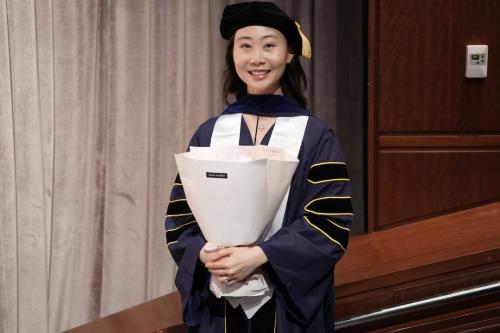
Advancing Multi-Agent AI: Jingdi Chen's Path from GW to Arizona
Rigorous research, mentorship, education, and hands-on training are hallmarks of a doctoral education in the ECE Department. With a desire to produce new knowledge, Jingdi Chen, Ph.D. ‘24, laid the groundwork for her academic career at GW Engineering. This year, she reached a significant milestone by beginning a tenure-track assistant professorship at the University of Arizona.
Chen’s doctoral research focused on cutting-edge methods in reinforcement learning, multi-agent coordination, and cybersecurity. She credits her mentor, Professor Tian Lan, with helping her think independently, communicate research clearly, and pursue ambitious goals. Her time as a teaching assistant highlighted the importance of meeting students where they are.
“I plan to carry these lessons into my teaching by focusing on clarity, engagement, and helping students connect theory to practical applications,” she stated.
In her lab, Chen will lead students in developing multi-agent systems capable of communication, coordination, and decision-making in complex environments, particularly using large-scale models to improve how agents interact and adapt. Her team is taking an interdisciplinary approach to advance multi-agent learning and develop trustworthy and secure artificial intelligence (AI) technologies.
With a technical foundation built at GW Engineering, Chen embodies the transformative impact of the department’s programs through her blend of foundational theory and applied research, translating AI research into real-world solutions while mentoring the next generation.

Shaping the Future of Semiconductor Chips
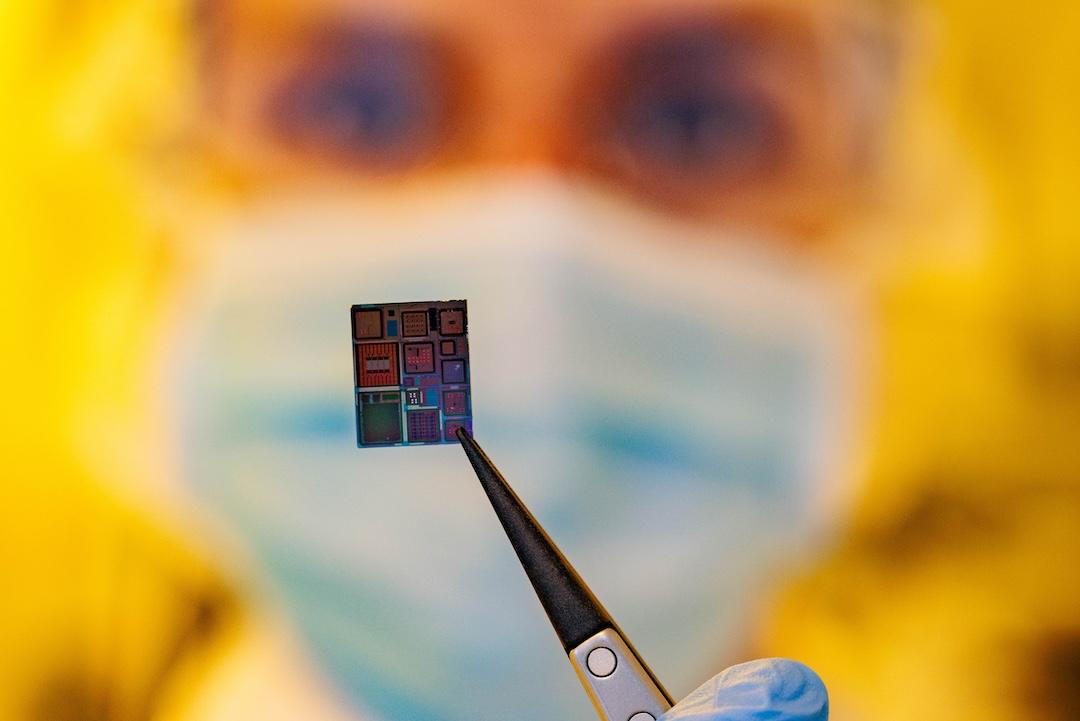
Semiconductor chips are used for various functions, including medical imaging, radar, and data processing. Improving semiconductor chips could strengthen these applications, help overcome long-standing limitations in building large scale quantum computers, and enhance the performance of future wireless networks, including sixth-generation (6G) communication systems.
Professor Weidong Cao is conducting research to harness physics principles, called non-Hermitian topological electronics, to pave the way for compact, energy-efficient, and highly reliable microwave circuits fully integrated on semiconductor chips.
The project combines non-Hermitian physics, topological protection, and integrated circuit design to challenge how microwaves can be generated, manipulated, and protected directly on a chip. These microwave circuits can generate and transmit signals more effectively than before, regardless of chip imperfections.
Cao and his team have prioritized student engagement in the research, with the project serving as a training ground for them to gain hands-on experience in chip design, physics, and engineering. GW’s cutting-edge facilities and industry connections help empower students to be the next generation of semiconductor and quantum research leaders.
Cao is excited by how his research is pushing the field’s boundaries. “The prospect that these circuits could one day underpin both practical quantum computers and next-generation wireless networks is inspiring, and it motivates me to push this research forward,” he shared.
ECE Excellence: Building Belonging and Community Strength
The ECE Department continues to center inclusive excellence in its mission, aiming to cultivate a community where every student, staff, and faculty has a strong sense of belonging and opportunities to thrive. Through research, outreach, and creative programming, the department is curating spaces that celebrate varied perspectives, support well-being, and empower the next generation of engineers.
A recent example is the ECE Blitz Showcase, where students presented projects ranging from energy systems to cybersecurity in an accessible and collaborative format. The event not only highlighted cutting-edge research but also gave students a platform to share their ideas with peers, faculty, and professionals, highlighting the department’s commitment to expanding the STEM pipeline by spotlighting voices at all stages of training.

ECE also fosters community through hands-on, lighthearted competitions designed to build both technical skills and camaraderie. At the Egg Launch Challenge, students worked in teams to design carriers for plastic eggs, mount them on drones, and navigate obstacles. The event blended coding, engineering design, and creativity, while encouraging teamwork. Similarly, the Gingerbread Circuit Competition invited participants to transform gingerbread house kits into engineering-themed creations—from candy cane circuit boards to sugary models of the Science and Engineering Hall. Each event offered a break from rigorous coursework and an opportunity for ECE students to build connections across the GW Engineering community.
Promoting cultural exchange is equally critical to the department’s mission. During IEEE PES Day, the department hosted “Engineering Across Borders: Grad Bites Global Flavors,” where students shared dishes and stories from their backgrounds. The event highlighted the global nature of engineering and reinforced that inclusive excellence means valuing perspectives from every corner of the world.
Through these efforts, the department intentionally builds an environment where academic excellence goes hand in hand with community, creativity, and inclusivity. They exemplify how inclusive excellence is not an add-on, but a defining priority—ensuring that all members of GW Engineering’s ECE community feel welcome, engaged, and able to thrive.
Discovery Lives Here: Cutting-Edge Facilities Drive ECE at GW
Spanning 500,000 square feet, GW’s Science & Engineering Hall (SEH) is home to the labs and classrooms where ECE students and faculty teach and learn, discover and invent.
On the basement level, the GW Nanofabrication and Imaging Center (NIC), equipped with state-ofthe-art lithography equipment, deposition, etching, and analysis systems, provides faculty like ECE Professor Gina Adam with the tools to advance brain-inspired chip technologies. In the “Micro and Nanofabrication Techniques” class, she trains students in using these specialized technologies as they practice optimizing chips through heterogeneous integration, designing and building new devices on top of existing microchips.
Through a DoD capacity-building grant, Adam enhanced GWNIC’s offerings by acquiring a dualchamber sputtering system that allows her interdisciplinary research team to better explore new materials for neuromorphic computing. This advanced equipment significantly strengthens Washington, D.C.’s position as a leader in energy-efficient neuromorphic computing while providing students from GW and collaborating universities with invaluable experience in emerging topics.
Moving up to the fifth and sixth floors, the department hosts countless research and teaching labs. The fully operational Smart Grid Control and Power Hardware-in-the-Loop (HIL) Testbed provides researchers and students with a unique opportunity for end-to-end testing of smart grid operations. A set of control and power HIL platforms is its latest addition, enabling real-time analysis and coordination of control and power exchange among critical components under normal and stressed conditions.

The department is also building a Physical Artificial Intelligence (PAI) Studio, slated to open in Spring 2026. Designed to support PAI modules in all undergraduate and graduate courses, the studio will feature impact-resistant quadrotor drones for multi-agent, swarm, and vision-based applications and autonomous vehicles, both equipped with Nvidia® Jetson™ technology. Comprehensive resources for teaching and research in physical and virtual environments will also be provided, including access to OS, FPGA, and GPU boards for AI-centric design, deployment, and configuration.
As ECE faculty establish labs and acquire new equipment, they not only keep GW Engineering at the forefront of scientific discovery but also enrich student learning. The SEH continues to be a vital enabler of our ambitions, allowing the department to responsibly translate innovations to society.
Driving Innovation Through Partnerships and Global Leadership
Through strategic partnerships with government, industry, and global research communities, the ECE Department is actively shaping the future of technology and workforce development. Recent initiatives underscore the department’s leadership across academia, policy, and innovation.

A centerpiece of this effort is a collaboration with the National Institute of Standards and Technology (NIST) via the $29.9 million Professional Research Experience Program (PREP). This partnership offers opportunities for GW undergraduates, graduate students, postdoctoral researchers, and faculty to work directly in NIST laboratories. Led within ECE by Professor Can Korman, the program enhances technical training, provides financial support, and establishes a robust pipeline for cultivating a more inclusive STEM workforce.
ECE faculty are also empowering early-career researchers nationwide. Professors Tian Lan and Weidong Cao co-organized the 2024 NSF CISE CAREER Workshop, helping junior faculty acquire the skills needed to secure highly competitive NSF CAREER awards. Conducted in collaboration with Virginia Tech and NSF program directors, this event demonstrates the department’s role in strengthening the academic community and nurturing innovation at scale.

On the global stage, Professors Tian Lan and Payman Dehghanian are enhancing the department’s visibility by bringing major international conferences to GW. Lan, as an area chair for INFOCOM, coordinated the first in-person Technical Program Committee meeting since the pandemic and gathered thought leaders for the inaugural INFOCOM Distinguished Lectures series. Dehghanian, as local organizing chair for the 4th International Conference on Smart Grid Synchronized Measurements and Analytics, convened over 160 researchers and developers to advance innovation in synchronized measurements and smart grid analytics.

Bridging academia and policy, Lan’s appointment to the Federal Communications Commission’s Technological Advisory Council highlights the impact of ECE faculty beyond campus. His contributions are influencing U.S. policy on emerging issues such as 6G networks, AI/ML applications, and spectrum management.
From cultivating the next generation of engineers to shaping national policy, the department is driving progress at the intersection of research, education, and public-private partnerships, expanding its impact through local collaborations to global leadership.
Forging Future Leaders Through Hands-On Learning
From spirited competitions to internships at leading companies, there’s no shortage of ways for ECE students to develop invaluable technical and professional skills both in and out of the classroom. The department empowers them to take charge of their career journey by actively embracing these opportunities.
ECE students are distinguished by their dedication to innovation and collaboration, which is clearly evident in their recent successes. For the fourth consecutive year, an ECE team won the school-wide capstone design competition with their project, “Reeflex: An Underwater Robotic System for Lionfish Detainment.” At Raytheon’s East Region Autonomous Vehicle Competition, another team took home the Most Innovative Design Award for their ambitious dual-drone system, where one drone scouts ArUco markers and sends their coordinates to an aerial delivery drone that delivers a medkit package.
Internships are another valuable avenue for gaining practical experience and enhancing one’s resume. For Ph.D. candidates like Osama Yousuf and HamidReza Imani, internships also deepen their research expertise by extending it into industry settings. Imani, who focuses on high-performance computing and generative artificial intelligence (AI), helped Modular design a verification tool to measure the accuracy of its AI software stack. Yousuf, specializing in energy-efficient neural networks, worked with Western Digital to evaluate large language models under varying noise conditions in analog AI accelerators, derive hardware specifications, and perform device characterization on crossbar arrays.

For undergraduates like Dylan Roberts, internships often serve as a window into potential careers. Through ECE Professor Gina Adam, Roberts landed a summer position at NIST investigating the properties of memory devices, particularly magnetic memory, and developing new measurement tools and methods for standardizing them. This not only provided him with valuable research experience but also helped him evaluate his next steps.
“It was really interesting to use the techniques I learned in my classes while also gaining new skills, and to merge theory with application in a way that produced reproducible results,” said Roberts.
By cultivating these hands-on experiences, the department fosters a rich environment that promotes professional growth, equipping students with the confidence to innovate and lead.